
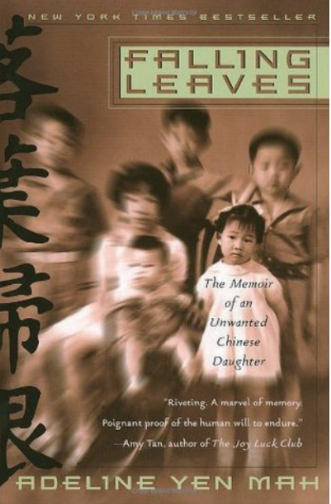
 “Falling Leaves is dedicated to all unwanted children with the wish that you will persist in doing
your best in the face of hopelessness; to have faith in the end your spirit will prevail, to transcend your abuse and transform it into a source of courage, creativity and compassion.”
- Adeline Yen Mah, Internationally acclaimed author/physician/Committee 100 member
落葉歸根一書,是要獻給所有不被歡迎的孩子們,希望他們能在絕望中堅持做到最好。能有信心戰
勝一切,並超越所受過的虐待且轉化為勇氣、創造力和同情心的源泉。
- 馬嚴君玲,國際知名作家/醫師/百人會成員
(The following text is an excerpt from the book Chinese Americans in Irvine 1971-2021)
 In September 2021 the University of California Irvine announced a planned medical research facility, supported by a $30 million lead gift from the Falling Leaves Foundation. The approximately 200,000 square-foot building will be set in UCI’s health sciences district along Michael Drake Drive, and it will include state-of-the-art laboratories and meeting spaces to foster groundbreaking research. The Falling Leaves Foundation was established by Prof. Robert A. Mah and Dr. Adeline Yen Mah in 2007. They describe their personal journeys leading to this donation.
Adeline’s Story
I was born in Tianjin, China. My mother died ten days after my birth. My father remarried and I had a miserable childhood.
When I was fourteen years old, I won an international writing competition which convinced my father to send me from Hong Kong to England for further studies. I took courses and carried out experiments in physiology and biophysics at London’s University College and was offered a scholarship to do basic research. The structure of DNA had been discovered and I attended a lecture titled ‘Gene Function’ given by Dr. Francis Crick one afternoon. Tall, imposing, eloquent and loud, Crick made an unforgettable impression.
Crick’s lecture outlined his belief of the nature of life. He stated that the main function of DNA is to control, directly or indirectly, the synthesis of proteins. He suggested that RNA is some sort of intermediate product between DNA and protein. ’There is a link,’ Crick
claimed, ‘between the base sequences of nucleic acids and those of amino acids in a protein. This link between gene and protein provides the flow of information that will reveal to us the secret of life itself.’
I was profoundly influenced by Crick’s talk and considered giving up medical school and devoting my life to nucleic acid research. But I had promised my father that I would become a doctor and did not wish to disappoint him. So I graduated from medical school, trained further in internal medicine and anesthesiology, emigrated to California, got married and practiced for many years as an anesthesiologist in Orange County, California.
From time to time, the dream of doing research would return and I would say to Bob, my microbiologist husband, ’One day, I will join you in the lab!’ but it never happened. Life went on and suddenly we were in our fifties. My father and stepmother died. The intrigue that followed between my siblings and me was emotionally shattering. I became depressed and wrote a memoir titled Falling Leaves. To my amazement, the book became an international best-seller and royalties accumulated. Not wishing to profit from this, Bob and I decided to donate the money to charity and started the Falling Leaves Foundation.
Meanwhile, we have been following the advances of medical technology in the literature. In 1978, there was the amazing feat of genetic engineering by Stanley Cohen and Herb Boyer who were the first to express a human gene in bacteria and thereby produce the human hormones insulin and somatostatin in massive quantities.
This was followed by DNA therapeutics. However, because all DNA drugs must penetrate the cytoplasmic membrane as well as the nuclear membrane to be effective, they raise serious concerns as they might integrate into the host genome.
RNA therapeutics, on the other hand, pose no risk of chromosomal integration since they do not penetrate the nuclear membrane. Because of this, I firmly believe that we are in the midst of a therapeutic revolution even more significant than recombinant protein technology.
RNA plays a key role in nearly every biological pathway. Coupled with genome editing tools such as CRISPR, every disease will be treatable.
The mission of Falling Leaves Foundation is to promote research and understanding of recent advances in medical science. When Bob and I were presented with a request from UCI to fund their 200,000 square foot innovative medical research building along Michael Drake Drive, we readily agreed. We hope that the cutting edge research that will be done here will shape the future of health and wellness for many years to come.
I have been given numerous opportunities ever since I emigrated here. For a Chinese female immigrant like me who did not know anyone, California’s generous people opened their doors and allowed me to work as long and hard as I wished. I am and will be eternally grateful for the chance to pursue my dreams and realize my full potential.
Hopefully, this building will repay in small measure the debt I feel I owe the United States of America. (Written by Dr. Adeline Mah)
Bob’s Story
I am a native Californian, born in Fresno. At the age of sixteen, I attended St. Mary’s College in Moraga as a scholarship student. I transferred to the University of
California system the next year; later, while changing campuses from UC Berkeley to UC Davis, I was drafted into the US Army. After a nearly two-year stint as an enlisted man stationed in Germany, I returned to UC Davis to continue my education.
During the late 1950’s, I was a student in the Department of Bacteriology when the faculty of UC Davis and UC Berkeley developed a joint inter-campus graduate program in Microbiology, launching the unifying concept of general microbiology. I chose the fork in the biological road leading to the study of methanogens and other anaerobes which became my main research area. I received my B.A., M.A., and Ph.D. from UC Davis. My first academic appointment was Assistant Professor of Biology at Cal State University, Northridge, in 1961, followed a few years later by a move to University of North Carolina where I had my first doctoral students.
Seven years later, I accepted an appointment at UCLA where I met and married Adeline. We bought a home in Huntington Beach, and I spent the remainder of
my teaching and research career at UCLA, finally retiring in 1995 from active teaching and research as Professor Emeritus. In recognition for contributions to my field of
study, two species of archaebacteria, Methanohalophilus mahii and Haloterrigena mahii, and the genus, Mahella australiensis, were named.
Adeline and I have often talked about the amazing discoveries and developments in modern science, especially in the biological and medical fields. However, we are long past the days when we can actively participate in the lab.
In the summer of 2021, we were presented with the opportunity to donate towards the erection of a 200,000 square foot building at the University of California, Irvine.
This building will enable UCI to recruit and retain high profile scientists. It will also allow students to learn alongside these researchers and physicians.
Since it has always been our dream to do medical research together, we felt that by donating this building to UCI, we have found the ideal partner to transform our vision into reality. (Written by Dr. Robert Mah)
(以下文字摘錄自《爾灣華裔紀實1971-2021》一書)
加州大學爾灣分校於 2021 年 9 月宣佈,加州大學名譽教授馬成輝及作家馬嚴君玲醫師,以落葉歸根基金會之名率先捐款 3000 萬美元,在爾灣加大校園興建面積20萬平方呎的落葉歸根基金會醫學創新大樓,以促進跨學科的基礎醫學研究,以下是這對慈善家夫婦親自撰寫的心路歷程。
馬嚴君玲的故事
我在中國天津出生,僅十天後喪母。父親再婚, 因而我的童年過得十分悲慘。
14 歲那年,我贏了一次國際寫作比賽,這事打動了父親,把我從香港送到英國求學。我進入倫敦大學選修生理學和生物物理學課程並參與實驗工作,獲得了進行基礎研究的獎學金。那時 DNA 的結構已經被世人發現;一天下午我參加了弗朗西斯‧克里克博士(Dr. Francis Crick)命題為「基因功能」的講座。他身材高大,氣勢雄偉,口才絕佳且聲音洪亮,給人留下
了難忘的印象。
克里克的演講概述了他對生命本質的信念。他說 DNA 的主要功能是直接或間接控制蛋白質的合成。他認為 RNA 是 DNA 和蛋白質之間的某種中間產物。克里克聲稱,「核酸的鹼基序列與蛋白質中的氨基酸的鹼基序列之間存在著聯繫」。基因和蛋白質之間的這種聯繫提供了信息流,它將向我們揭示生命本身的秘密。
克里克的演講深深地影響了我,我考慮過放棄醫學院,專心從事核酸研究。但我已經向父親保證我會成為一名醫生,不想讓他失望,所以我在醫學院畢業後,又接受了內科和麻醉科的培訓。之後移民到加州,結婚並在加州橙縣擔任麻醉科醫師多年。做研究的夢想不時地回到腦中,我會對我的微生物學家先生鮑勃說:「總有一天,我會和你一起進入實驗室!」 但它從未實現。
時光飛逝,突然之間我們已經 50 多歲了。我的父親和繼母先後去世。我和兄弟姐妹之間在情感上的糾紛令人崩潰。我感到沮喪並寫了一本名為《落葉歸根》的回憶錄。令我驚訝的是,這本書成為全球暢銷書, 而且版稅收入可觀。我不想從中獲利,鮑勃和我決定將這筆錢捐給慈善機構,並成立了「落葉歸根基金會」。
同時,我們一直在關注文獻中醫療技術的進步。1978 年,Stanley Cohen 和 Herb Boyer 的基因工程取得了驚人的成就,他們是第一個在細菌中顯示人類基因,從而大量生產人類激素、胰島素和生長抑素的團隊。
緊隨其後的是 DNA 療法。然而,因為所有 DNA藥物都必須穿透細胞質膜和核膜才能有效,它們可能會影響到宿主基因組織內部,因此引起了嚴重的關注。
另一方面,RNA 療法不會造成染色體整合的風險,因為它們不會穿透核膜。正因為如此,我堅信我們正處於一場比重組蛋白技術更重要的治療革命之中。RNA 在幾乎所有生物途徑中都起著關鍵作用。再加上 CRISPR 等基因組編輯工具,每種疾病都可以治癒。
「落葉歸根基金會」的使命是促進對醫學、科學最新進展的研究和理解。當鮑勃和我收到 UCI 要求資助他們在 Michael Drake 大道上的創新醫學研究大樓時,我們欣然同意。我們希望在這座大樓展開的先進研究,將會提升人類未來的健康和幸福。
自從移民到美國以來,我得到了很多的機會。對於像我這樣一個不認識任何人的中國女移民來說, 加州慷慨的人們為我敞開了大門,讓我可以隨心所欲地努力工作。我永遠感激能有這個機會去追求我的夢想,並發揮我的全部潛力。希望這棟大樓能在一定的程度上,讓我給與美國一些回饋。(中文翻譯:黃少華)
馬成輝的故事
我出生在加州弗雷斯諾市 (Fresno),是土生土長的加州人。16 歲時,我獲得了位於莫拉加的聖瑪麗學院(St. Mary’s College in Moraga)的獎學金,在此學校就讀。第二年,我轉學到加州大學,當我從加州大學柏克萊(UC Berkeley)分校轉到戴維斯(UC Davis)分校時,我被徵召入伍;在德國服役近兩年後,我回到加大戴維斯分校繼續學業。
1950 年代後期,當我還是細菌學系的學生時,加大戴維斯分校和伯克萊分校的教授們開展了一個微生物學的校際聯合研究生課程,啟動了通用微生物學 (general microbiology)的統一概念。在科學研究的路上,我最終選擇了研究產生甲烷菌和其他厭氧菌研究的生物學,作為我的主要研究領域。我在加大戴維斯分校獲得了學士、碩士和博士學位。1961 年,我在加州州立大學北嶺分校擔任生物學助理教授,那是我的第一份教職,幾年後我搬到了北卡羅來納大學,在那裡,我指導了我的第一批博士生。
七年後,我接受了加州大學洛杉磯分校(UCLA)的教職,並在那裡我遇到了我的妻子嚴君玲(Adeline Yen Mah)。我們在亨廷頓海灘市買了房,之後我在加州大學洛杉磯分校度過了長達二十多年的教學研究生涯,我於 1995 年退休,成為名譽教授。為了表彰我在研究領域上的貢獻,有兩種古細菌 Methanohalophilus mahii 和 Haloterrigena mahii 及其屬性 Mahella australiensis 以我的姓氏命名。
君玲和我雖然經常談論現代科學在生物和醫學領域驚人的探索與發展,但是我們積極參與實驗研究的日子已成為過去。2021 年夏天,我們決定捐款為加大爾灣分校(UC Irvine)建造一座 200,000 平方英尺的建築。這棟大樓將促使 UCI 能夠招募並吸引更多知名科學家,並讓學生們、研究人員和醫生一起學習。因為一起做醫學研究一直是我們夫妻的夢想,通過捐贈這座建築大樓,讓我們找到了理想的合作夥伴,使得我們的願景化為現實。(中文翻譯:李佳禾)