

張世厚因工作緣故參加健言社多年,培養出英語演說及邏輯思考的領導力 Shih How Chang credits his leadership style to the training of public speaking and logic thinking at the Toastmasters International Clubs
(The following text is an excerpt from the book Chinese Americans in Irvine 1971-2021)
Shih How Chang, who has lived in Irvine for more than 40 years, specializes in structural engineering and aerodynamics. He has worked in aerospace companies for many years. Because the company encouraged employees to actively participate in the community, Chang has volunteered in the South Coast Chinese Cultural Association (SCCCA) and the Irvine Chinese School (ICS). From 1989 to 1992, he served as the principal of the Irvine Chinese School. From 2001 to 2003, he served as the president and co-chairman of the South Coast Chinese Cultural Association. Recalling that busy time, Chang believes that the connection with the community through voluntary services is very meaningful. Although there are inevitably differences in opinions among the volunteers, it is also through the selfless efforts, communication, and cooperation that many valuable accomplishments have an enduring impact on the community.
In the early 1990s, the Irvine Chinese School rented the classrooms in the University high school every Sunday. Chang noticed that some students were “procrastinating” when coming into the classroom which disrupted the learning of the whole class, so he enlisted some volunteer parents to record the attendance. Students who were tardy more than three times must attend a meeting with their parents. Such strict implementation of the punctuality rules has won the confidence of the parents, and gradually the reputation of Irvine Chinese School was established.
While Chang was the president of the South Coast Chinese Association, the parents of Irvine Chinese School were actively raising funds for the school building. Chang, a structural engineer, often negotiated with the city government on the building design and the experience made him realize how much the local government values the voice of its residents.
Before the cultural center was built, nearby residents had questioned the possible traffic issues and environmental impact. The city held a public hearing specifically for this purpose. Diane Tang-Liu organized a group of ICS alumni and supporters as speakers advocating the construction of the South Coast Cultural Center. The perspectives of their personal stories and the benefits for community development eventually persuaded the planning committee to approve the project application. However, to comply with the building codes of the city, the shape of the Confucius Hat in the Cultural and Educational Building had to be modified. The Chinese Garden must be built within the surrounding walls. Many similar obstacles were overcome with the tireless efforts of those involved in the construction process. Finally, the Kuan-Yuan Tai Educational Building was completed and the dreams of many parents and students were fulfilled.
After retiring, Chang often practiced Tai Chi in the park. The increasing number of participants and the use of swords and sticks in the routine aroused the attention of some people, who reported to the city that the Tai Chi group occupied the basketball court. One morning, the city officials came with an ordinance and told the Tai Chi group that the basketball players have priority in using the courts. Chang realized that even though both Tai Chi and basketball are sports, they were treated differently. During the renovation of the community center, Chang petitioned the city to add a Tai Chi court outside the center, and he even proposed a design of the court. He stressed that the morning exercise group consists of residents from different ethnicities.
After repeated negotiations, the city finally approved the addition of the Tai Chi court. Four citrus wooden crates commemorating the Irvine Ranch period were embedded in the octagonal Tai Chi court. Though the court differed from the original design, Chang was appreciative of the City's inclusive attitude in accommodating the residents’ needs. In 2013 the first Tai Chi court, designed and completed by a SoCal city, opened in the Northwood Community Center. It is the pride of many Irvine residents. (English translation by Betty Mak)
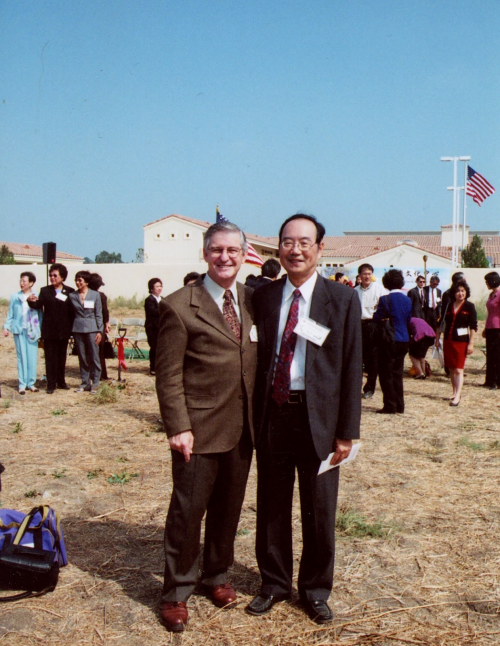 (以下文字摘錄自《爾灣華裔紀實1971-2021》一書)
定居爾灣 40 餘年的張世厚,專業是結構工程及航 空動力,曾在航太公司工作多年,由於公司鼓 勵員工積極參與社區,張世厚本著服務的初衷,投入南海岸中華文化協會(SCCCA)及爾灣中文學校, 1989 到 1992 年擔任爾灣中文學校校長,2001 年到 2003 年擔任南海岸中華文化協會會長及共同會長。回 憶起那段忙碌的時光,張世厚認為,經由義務服務建 立與社區的連結,是很有意義的事。雖然在服務過程 中難免有意見不同之處,但也是靠眾人無私的付出, 經由溝通協調互相包容合作,才能在社區中留下一些 值得稱道的痕跡。
90 年代初的爾灣中文學校,每週日租用爾灣學區 大學高中上課,張世厚看有些學生「進教室拖拖拉拉」,影響全班上課時間,就與義工家長們合作,記下遲進教室的學生,遲到超過三次就要安排與學生家長開會。這樣嚴格執行準時上課的校規一段時間後, 反而贏得家長的信心,逐步建立起爾灣中文學校的聲譽。
張世厚出任南海岸華協會長時,適逢爾灣中文學 校家長們積極籌款建校,擅長結構工程的張世厚常與 市政府就校舍設計進行交涉,更讓張世厚體驗到美國 地方政府對居民的重視。 興建文化中心之前,附近居民曾質疑可能引起的 交通及環境問題,市府特別為此召開公聽會,SCCCA 由湯丹霞組織一批中文學校畢業生與支持者,輪番上 台說明興建南海岸中華文化中心的理由,從個人經歷 到社區發展等不同的角度,打動了市府計畫委員會, 通過建案申請。但是為了符合市府的建築規範,文教 大樓孔子帽的造型得進行修改,中式庭園必需建在圍 牆內,興建過程中許多類似的障礙,最後都在眾人的 努力下克服,讓戴廣源文教大樓得以完工啟用,也實 現了家長與學生們多年的美夢。
退休後,張世厚經常在公園裡勤練太極拳,由於 拳友人數日增,再加上有人帶著劍、棍等練習器材, 引起少數人側目,以太極拳佔用籃球場為由向市府檢 舉。有一天,市府人員出現,拿出條例說:「只要有 人來打籃球,你們就得馬上讓開。」張世厚認為,同 樣是運動,為何有不公平待遇? 於是趁市政府翻修社 區中心的機會,張世厚到市議會請願:「太極拳對每 個人身體健康都有幫助,希望在改建的社區中心外加 入太極練習場。」他還向市府提出太極練習場的參考 設計圖,並強調參加太極晨練的人群中,包括各族裔居民。
經過再三交涉,終於獲得市府首肯,但是將木地 板改為水泥地,並在八角形的太極練習場中,嵌入四 個紀念爾灣農場時期的柳橙木箱標誌,雖然不同於原 始設計,但是張世厚肯定爾灣市府人員,聽取居民需 求的包容心態,更欣見南加州第一個由市政府設計完 工的太極練習場落地爾灣,2013 年起在 Northwood 社 區中心免費對外開放,成為令爾灣居民引以為傲的景 點。(蕭迪玉撰文)