
 Dr. Nelson Mar grew up in the small city of “Guanghan” in Sichuan Province located in central China. As a young child, he often heard bombers taking off and landing at nearby U.S. Air Force airfields. Later, he learned that the United States and China were allies. The U.S. Military was helping to achieve peace in a wartorn China. After the defeat of the Japanese army, his father was an engineer responsible for taking over Taiwan on behalf of the National Government. In late 1945, his family moved to Taiwan, which had just been freed from the Japanese occupation. His father was the director of sugar factories throughout different cities in Taiwan.
Nelson spent his childhood growing up in Taiwan. He not only received a good education at Chung Yuan Christian University, but he also learned the traditional Chinese philosophy of “Heaven helps self-helpers”. In 1966, he left Taiwan and came to the United States. After obtaining a master’s degree in science and technology from Tennessee Tech, he earned his doctorate in mechanical engineering at Ohio State University. Although there were jobs offered by companies from all over the world, he believed that he should remain in the United States to apply what he had learned. He also felt that he could repay the country that helped China defeat Japan.
Dr. Mar first worked at Bechtel Power Company designing nuclear power plants. At that time, nuclear power was at the forefront of clean energy technology. His team designed the containment structure for two nuclear power plants in San Onofre California, and also collaborated with another team to develop computer software to design nuclear power plants. It was important for his nuclear power structures to withstand both high seismic and thermal forces to ensure safety in the community. He was extremely proud when his San Onofre’s nuclear power plant design was approved by the government’s Nuclear Regulatory Commission.
In 1979, Dr. Mar joined The Aerospace Corporation, a non-profit company funded by the U.S. government that restricted it to only cooperate with the U.S. Air Force (USAF) in military space research projects. He was excited to participate in many important high-tech space programs, which helped the United States and the world provide the basic branches of space development. Over the next 22 years, he participated in many influential and important projects, such as the launch of GPS satellites and the use of Delta II and Titan IV rockets to launch many of the most secret national security missions in the United States. He also designed next-generation launch satellites as well as the Delta IV and Atlas V rockets. For his contributions, Dr. Mar has received certificates of appreciation from the U.S. Air Force Lieutenant General, Major General and many colonels. He formally retired from an aerospace company in 2001, but continued to work part-time to provide training for the next generation of engineers on certain key projects.
Nelson also founded the US-China Aerospace Association with many fellow aerospace engineers. The main purpose is to increase mutual learning and research among members while aligning with international standards. Nelson has been the president of the Southern California American-China Aerospace Association and the president of the National American-China Aerospace Association. In this role, he has held many academic conferences in the United States, China and Taiwan.
In his spare time, Nelson participates in several local community service projects. He has served as the President and Chairman of the South Coast Chinese Cultural Association and later supported the construction of the Chinese Cultural Center. He also has served many leadership roles in the Irvine Chinese School. In 2017, he donated the Mar Amphitheater to increase outdoor venue space.
In 1991, Nelson established a non-profit organization “Asian American Senior Citizens Service Center (AASCSC)”. AASCSC pledged to provide support to the elderly Asian immigrants in their adopted country with various activities from employment services to health care. AASCSC has its office in Santa Ana to provide full time services for Asian elders. The South Coast Chinese Cultural Center and the Asian American Senior Citizens Service Center have continuously served the society based on the Chinese philosophy of taking care of the community youths and elders as your own. In 2006, Nelson was awarded the Outstanding Alumni Award of Chung Yuan Christian University in Taiwan. (Courtesy of Dr. Nelson Ma)
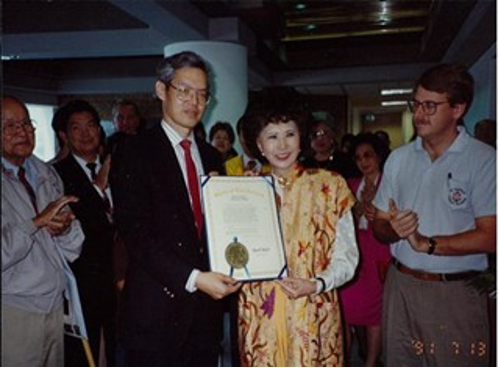
Nelson with March Fong Eu at the opening of AASCSC in 1991
1991年亞美老人服務中心的開幕儀式中,馬在莊獲加州州務卿余江月桂表彰。
馬在莊博士是浙江省台州市人,在中國中部四川省的小城「廣漢」長大。幼年時期他每天早晚都聽到轟炸機在附近的美國空軍機場起飛及降落,他得知美國與中國是同盟,美軍在幫助中國實現和平。 日軍戰敗後,他父親是代表國民政府接收台灣的工程師,全家 1945 年後期移居台灣。他父親在台灣各地糖廠擔任廠長。
馬博士在台灣度過年幼成長的歲月,他在中原大學接受良好教育,還學到中國傳統「天助自助」的哲學。1966 年,他離開台灣來到美國。獲得田納西科技大學(Tennessee Tech)碩士學位後,即在俄亥俄州立大學的(The Ohio State Univ.)工程力學領域攻讀博士學位。畢業後儘管有來自世界各地的工作機會,但他選擇留在美國,以報答這個曾幫助中國戰勝日本人的國家。
馬博士首先在 Bechtel 電力公司工作,設計核能發電廠。當時,核電算是清潔能源技術的最前沿。他的團隊為位於南加州 San Onofre 的兩個核電廠設計了圍護結構(Containment Structure),還與另一個團隊合作研發了設計核電廠結構的電腦軟體,可用於分析受到高地震力和熱力下的核電結構,有助於確保核電廠的安全。當 San Onofre 的核電廠設計獲得政府核監管委員會批准時,他感到非常高興。
1979 年,馬博士到太空航天公司(The Aerospace Corporation)工作,這是一家美國政府資助的非營利公司,它限制只能與美國空軍(USAF)合作從事軍事太空科研項目。他為能參與美國高科技太空計劃而感到興奮,這將有助於美國向太空發展。在接下來的 22 年中,他參與了許多重要的項目,例如 GPS 衛星的發射,及用 Delta II 和 Titan IV 作運載工具(火箭),發射了許多美國最機密的人造衛星,以及參與研發下一 代發射衛星的火箭,例如 Delta IV 和 Atlas V 火箭。由於他的貢獻,他獲得美國空軍中將、少將和許多上校的感謝狀。他於 2001 年從航空航天公司正式退休,但繼續兼職工作,為某些關鍵項目的下一代工程師提供訓練。
除了上班外,馬博士也同許多同行的航太工程師朋友們,創立了美華航太協會。主要是希望能夠增加會員之間的互相學習研究,同時跟國際上能夠接軌。 馬博士曾擔任南加州美華航太協會會長及全美美華航太協會總會長,並多次帶隊去中國大陸及台灣開學術會議。
在業餘時間,馬在莊盡可能地參與當地社區服務項目。他曾擔任南海岸中華文化協會理事長,從參加會章修訂委員會,到支持協會和中文學校建築和管理,並於 2017 年捐贈了一個 Mar Amphitheater 以增加戶外活動場地。
1991 年,馬在莊還聯合三個橙縣社團成立非營利組織亞美老人服務中心,並擔任創始會長,服務中心以幫助亞裔移民適應在異國的生活。AASCSC 在聖安娜(Santa Ana)購買自己的辦公室,為橙縣華人提供服務。今天,南海岸中華文化中心和亞美老人服務中心繼續本著「幼吾幼以及人之幼,老吾老以及人之老」 的中國哲學來服務社會。2006 年馬在莊獲得台灣中原大學傑出校友獎。(馬在莊博士提供)