
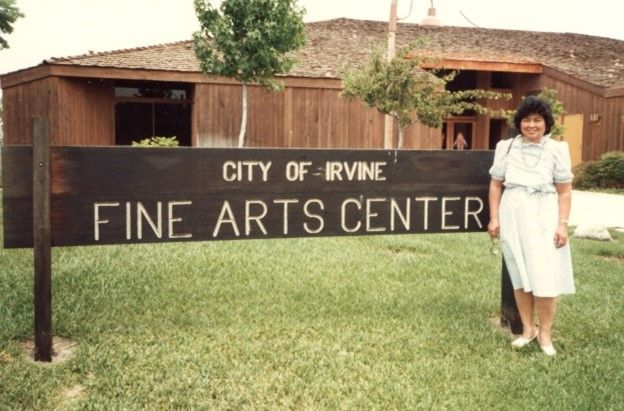
Ve-na teaches Chinese brush painting at the IFC for almost 30 years
鍾維娜在爾灣市立美術館教國畫班持續近30年。
(The following text is an excerpt from the book Chinese Americans in Irvine 1971-2021.)
Although biology was her major in college and graduate school, Ve-na Chen feels it was her father’s influence—exposing her at a tender age to Chinese opera and brush painting—that was to steer the direction of her life. While studying in New York, she joined the local amateur Chinese opera troupe where she met Nien-tsu Hu, a renowned brush painting artist, and started taking classes from him.
In 1977, Ve-na and her family moved to Irvine. Not long after, she went to work at the Student Health laboratory at UCI. “Irvine had gained cityhood less than ten years before; the population stood at just over 30,000 and it still retained a small-town aura,” recalls Ve-na. Irvine had huge expanses of undeveloped land. There was the zoological park, Lion Country Safari, and a huge amphitheater. She often had occasion to enjoy large-scale stage performances, take the children to the zoological park, the water park, etc. She was very pleased with the living conditions in and around Irvine.
In those days, the Irvine Chinese School (ICS) rented classrooms from the Irvine Unified School District (IUSD) on Sundays to hold classes. ICS simultaneously offered classes for the parents in chorus, social dance, flower arrangement, Chinese brush painting, etc. Ve-na was asked to teach the brush painting class for parents. She remembers many students being professional elites with Master’s and Ph.D. degrees. Their enthusiasm in learning traditional Chinese calligraphy and painting gave Ve-na a rewarding sense of achievement.
In 1983, Ve-na was invited by the Irvine Fine Arts Center (IFC) to teach a Chinese brush painting class. This appointment was to last until her retirement in 2012. There she taught Chinese brush painting in English. Among its ethnically diverse students, quite a few were total novices who had never before held a brush pen. Ve-na would start from the very beginning, patiently introducing them to the “scholar’s four treasures” (brush pen, ink stick, inkgrinding slab, and paper). Next, she would teach them to write their names in Chinese, using a brush pen. Then they would progress to painting flowers, birds, and landscapes.
To encourage creativity, she would hold student/ teacher joint exhibits at IFC. On her own, she often participated in IFC’s All Media exhibitions. Among the splendidly competing Western works, her landscapes would stand out, communicating a sense of “still waters run deep” and adding another dimension to the multicultural art world in Irvine.
Feeling that even without knowing the Chinese language, non-Chinese can enjoy Chinese brush painting/ calligraphy, Ve-na had her works printed on fans, clothing, tote bags, cups and cards. These little utilitarian items bearing Chinese calligraphy/brush painting were very well received at the Studio Art Festivals, Harvest Festivals, and Global Village Festivals. They served as seeds in disseminating Chinese culture, and in attracting students to Chinese brush painting classes.
To devote herself fully to the care of her dementiaafflicted husband, Alwin Chen, Ve-na resigned from her day job and her teaching. Shortly into her retirement, on the suggestion of some students, she decided to try teaching Chinese brush painting over the internet. With help from several students, Ve-na started her website, lovingchinesebrushpainting.com. Each month, she would produce a segment based on a different theme. She began with introducing the “scholar’s four treasures ”, then she proceeded to demonstrate how to paint bamboos, plum blossoms, orchids, wisteria, morning glory, bees and butterflies, small birds, rocks, pandas, tree bark and leaves. She has produced more than 20 tutorials with English instructions and subtitles, attracting students from around the world. (English translation by Sally Feng)
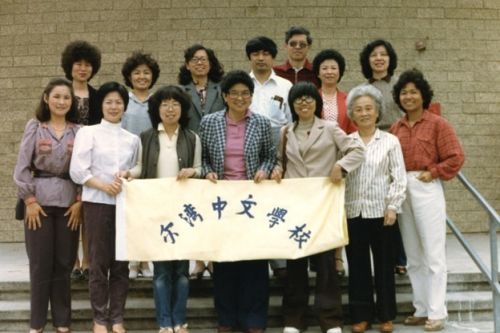
Ve-na’s first class at ICS with elites from different professions
鍾維娜曾在爾灣中文學校開國畫班,第一期吸引了來自各行各業的菁英。
(以下文字摘錄自《爾灣華裔紀實1971-2021》一書)
雖然在大學及研究所主修的是生物,鍾維娜受父親潛移默化,自幼接觸京劇與國畫,留學美國紐約時,曾參加當地京劇票友活動,並隨胡念祖學習國畫。
1977 年鍾維娜與家人從紐約遷來爾灣,後來進入爾灣加大學生保健中心實驗室工作。當時爾灣建市不及十年,居民才三萬多,仍保有小城的氣氛,鍾維娜回憶說,爾灣那時候有大片未開發的空地,還有野生動物園 Lion Country Safari 及大型露天劇場等,她經常有機會去看明星的大型演出,也會帶孩子去野生動物園、水上樂園,對爾灣附近的生活環境十分滿意。
當時的爾灣中文學校仍是租用爾灣學區教室,利用週日上午上課,同時也為家長們開設合唱、社交舞、插花及國畫等課程,鍾維娜受邀每週日主持華人家長的國畫課。她記得當時上國畫課的家長中不乏擁有碩士、博士學位的專業菁英,但對學習傳統書畫卻充滿熱情,讓她上起課來格外有成就感。
1983 年起,鍾維娜受邀到爾灣市立美術館(Irvine Fine Art Center)開國畫班,一直到 2012 年才自美術館榮退。鍾維娜在爾灣市立美術館以英語教國畫,不同族裔背景的學生中,不乏完全沒拿過毛筆的新手, 鍾維娜從頭開始,耐心的教他們親近文房四寶,用毛筆寫中文名字,再進級到畫花鳥山水。
為了鼓勵學生創作,她多次在市立美術館辦師生國畫聯展,同時,鍾維娜也經常參加爾灣市立美術館主辦的多媒介聯合藝展,在爭奇鬥艷的西方藝術作品中,她的山水畫獨樹一幟,傳達寧靜致遠的意境,也讓參觀者見識到爾灣藝壇多元化的一面。
鐘維娜認為,許多洋人雖然不懂中文,卻能欣賞國畫及書法藝術,因此,她把自己的作品印在扇子、 衣服、布提袋、馬克杯及卡片上,這些帶著書畫之美的實用小物,在爾灣市的 Studio Art Festival 、Harvest Festival 及 Global Art Festival 的攤位上大受歡迎,意外成為傳播中華文化的種子,招來更多想學國畫的洋學生。
為了全心照顧患失智症的老伴陳卓華,鍾維娜先後辭去工作與教學,退休不久之後,在多位學生建議與協助下,2018 年起鍾維娜開始嚐試透過網路視頻傳授國畫技法。她的網站 lovingchinesebrushpainting.com 每月推出新主題,從最基本的文房四寶開始,陸續介紹竹子、梅花、蘭花、紫藤、牽牛花、蜜蜂與蝴蝶、 小鳥、石頭、熊貓、樹幹及樹葉畫法,迄今已推出二十餘集免費教學影片,她的教學影片附帶英文講解及文字說明,吸引來自世界各地愛好國畫的學生。(蕭迪玉撰文)