
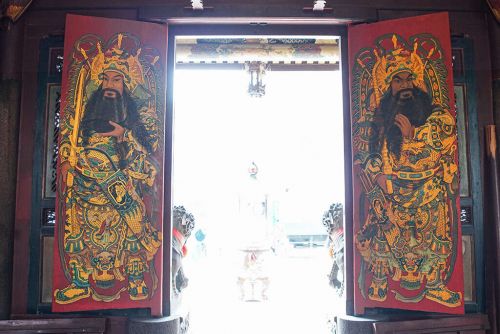
 The Lunar New Year is coming soon. During the Lunar New Year, in addition to pasting blessing characters and writing Spring Festival couplets, many families will also post "Door Gods (Menshen)" on the door. Although with the development of the times, fewer and fewer people follow the Door Gods, the Door Gods represent a shining point of Chinese culture and protect people's peace and happiness in a unique way.
According to records, the origin of the Door Gods can be traced back to ancient mythology. One of the most famous stories is about two warriors who were named Door Gods because of their bravery and proficiency in fighting, so that they could guard the palace gates and ward off evil spirits. Later, as time went by, the Door Gods slowly spread to the public. In order to get the same protection from the warriors, the common people would paste their portraits outside the door of every household. This is how the folk Door Gods evolved.
From ancient times to the present, the image of the Door Gods have also evolved with the changes of dynasties. The origin of Door Gods dates back to the Tang Dynasty. They became popular in the Song Dynasty and their images began to be diversified. Some Door Gods have ferocious faces, while others have benevolent faces. During the Ming and Qing Dynasties, the image of Door Gods became more fixed, usually appearing in pairs, or with men and women, symbolizing the harmony of yin and yang. From a regional perspective, Door Gods in different regions also have different characteristics. In the north, the image of Door Gods usually looks tall and powerful, reflecting the heroic and tenacious character of northerners; while in the south, Door Gods are more kind and gentle, reflecting the restrained and gentle side of southerners. Not only that, ethnic minorities also have their own unique door gods. For example, the Door Gods in Tibetan areas have strong religious features, giving people a sense of cultural mystery.
As a shining point in Chinese culture, the Door Gods carry history and beliefs, and also entrust a national spirit. As a cultural symbol, it connects the past and the present.
圖片來源: 台南旅遊網https://www.twtainan.net/zh-tw/attractions/detail/682
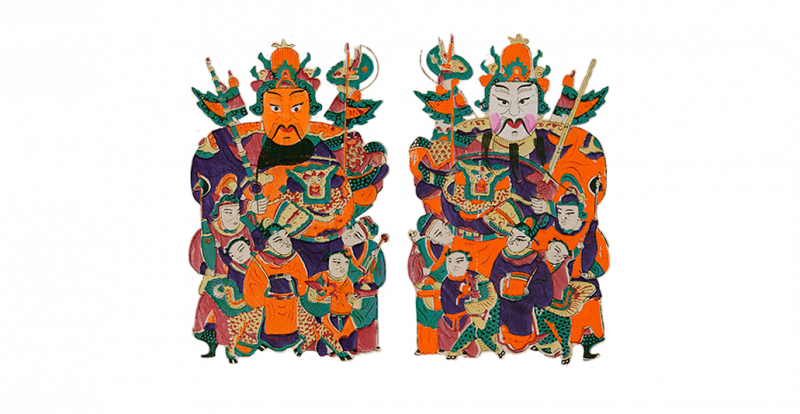 馬上就要到農曆新年了,在農曆新年期間,人們除了貼福字,寫春聯以外,很多人家還會將“門神”貼在自己的大門上。雖然說隨著時代的發展,越來越少的人貼門神,但是門神代表了中華文化的一個閃光點,它以獨特的方式守護著人們的平安與幸福。
根據記載,門神的起源要追溯到古代的神話故事。其中最著名的一個故事是關於兩位勇士,因為他們英勇善戰所以被封為門神,從而鎮守宮門,驅邪避凶。後來,隨著時間的推移,門神慢慢傳到了民間。老百姓們為了同樣得到勇士的保護,於是家家戶戶都要將他們的畫像貼在大門外,民間的門神就是這樣演變而來的。
從古至今,門神的形象也隨著朝代的變化而演變。門神起源與唐朝,在宋代開始流行,形象開始多元化,有些門神面目猙獰,而有些則慈眉善目。到了明清時期,門神的形象更加固定,通常是成對出現,或者男女搭配,象徵的陰陽和諧。從地域劃分來說,不同地區的門神也是具有不同的特點。在北方,門神的形象通常看上去高大威猛,從而反應出北方人豪邁、堅韌的性格特點;而南方的門神則更加慈祥與溫和,從而體現出南方人內斂、柔和的一面。不僅如此,少數民族也有自己獨特的門神,例如藏族地區的門神就是帶有濃厚的宗教色彩,給人一種文化的神秘感。
門神作為中華文化中的一個閃光點,它承載著歷史和信仰,同時也寄託了一種民族精神。它作為一種文化象徵,連接著過去與現在。
圖片來源: 湖南博物館 https://www.hnmuseum.com/zh-hant/learn/%E4%B8%AD%E5%9C%8B%E6%B0%91%E9%96%93%E5%82%B3%E7%B5%B1%E6%95%85%E4%BA%8B%E2%80%94%E2%80%94%E8%B2%BC%E9%96%80%E7%A5%9E%E7%9A%84%E7%94%B1%E4%BE%86